Moving On (Randy Moves North)
At first glance, the land looks as if it has been overrun by an overzealous hoarder. There's a broken-down lawn mower wrapped in the underbrush and bramble, cooking in the hot Northern California sun. There are thirty-year-old RVs and campers that obviously haven't moved in an easy decade, along with the random detritus of potted plants and garden hoses and nearly feral cats roaming the property.
ㅤ
If you allow your eye to follow the hill downward, away from the cemetery that sleeps peacefully across the street, you’ll see a small plot of land that has been staked and raked and pushed precipitously in delirium and in fervor; the result of a gentleman farmer’s urge to see the crooked and unyielding plants grow straight when it was demanded of them.
ㅤ
It could, if you allowed your darker ruminations to take over, be a place where a person ends up against their will rather than somewhere they choose to live—but there is life here if you know to look for it. My friend, Randy, who has lived here a spell longer than I could have managed, tells me of the crickets and frog song that ease their mournful call over the evening darkness; he tells me how he sits in a bathtub outside, out among the longways sigh of a land that does not bend without effort, and listens to them while he has a drink or a smoke or both. From his vantage here, he can watch the world in a sort of detached fascination, as it moves sideways against the grain of its own frenetic pace and pallor.
Randy is a man that pushes his hands into unyielding Earth, expecting that he will make a big enough dent in the world if he picks at a scab of dirt long enough. He lives with an expectation that it (and everything else) will deliberately give the same effort back to him so long as he is able to care enough for it. And it does and most things do. The land gives what is put into it, given that you tend to it, and long has he been a husbandman to the plot of fervor here. Raking and digging and toiling in the hot midday. Randy hopes for the same from the people in his life--that they will give the same effort that he has managed to put into them--but he is often disappointed.
ㅤ
He is not surprised by this, because what man of forty doesn’t already know to expect little from the humans around him? But that doesn’t change disappointment.
ㅤ
I don’t mean to make him sound like a saint or a sinner. He’s just a man. He is at once soft, hugging me fiercely when I arrive and is as ready to punch your lights out if you push his temper further than is necessary for the discussion. He readily admits that he drinks too much for an already mostly pickled liver; that he smokes too much cannabis, and can some days feel it in his lungs; he’s annoyed easily by certain people, by people who are callous and unassuming by their place in the world. And he will admit that, just as equally, he’s rough around the edges in spots, too. Some of us soften up as we get older, some of us turn jagged and blunt, and others will slowly become scrambled versions of their parents. Randy is trying very hard not to do the latter, but he’s fine with softening and turning jagged as it suits him. He’s a man that believes in soil, in the toil of effort, and is waiting on the world to believe in him.
ㅤ
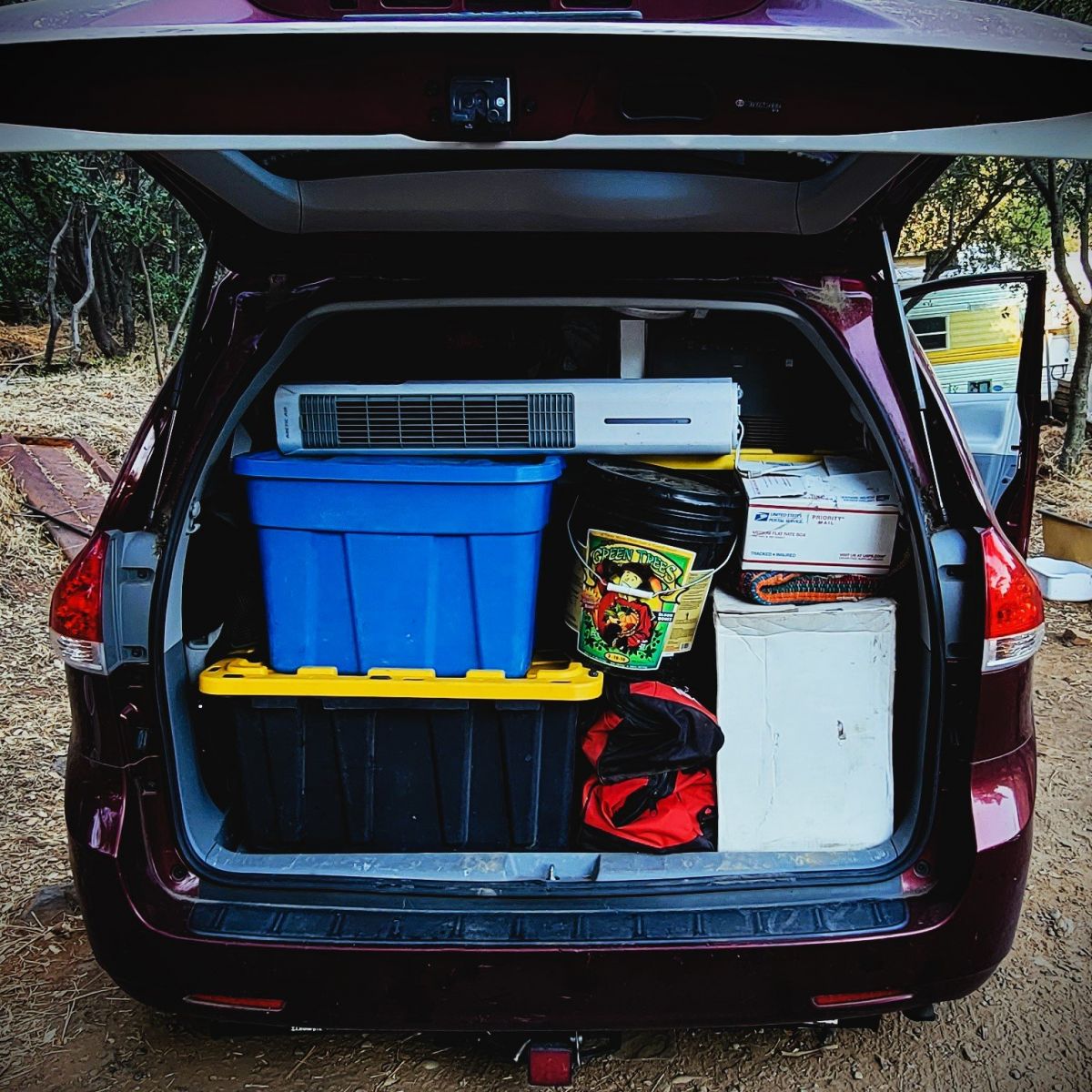
We packed his belongings into my van over the span of a few hours—several plastic tubs of clothes, tools, mementos; several potted plants of various growth and size; an old sign that used to demark the location of wildfire damage; posters, pictures, and all the requisite nostalgia that are associated with them; a calico cat named “Page” who was not so keen on her new cage and the strange sights and smells; and a freezer that weighed an ungodly amount for two people trying to lift it in the hot California sun.
ㅤ
It's strange to think that a life can fit in a van. We’re careful not to attach meaning to our possessions, for fear that they will become the momentary rulers of our world. But regardless of those misgivings, they are a part of us. They make a small plot of dry land in the middle of nowhere feel like home. They are the anchors that we reel in and put out as we see fit; as we move from place to place, from tiny apartments and houses to whatever squalor or luxury we find.
ㅤ
We’d planned on leaving the next morning, Sunday, but there was an energy in the air, electricity. Or perhaps we were simply impatient to get moving. We are both, it seems, people who would rather complete a task that is staring them in the face. Either way, a short time after I’d driven the eight hours South to his land in the middle of nowhere, we were driving North again. Back to Oregon.
ㅤ
We left at just past seven o’clock in the late evening.
ㅤ
As we left and made our way to the freeway, Randy talked about the neighboring farms and fields near where’d been living; about how the rice farmers had such precise leveling of their fields that the water can slowly and deliberately descend from one end of a plot to the next; how the water systems and nearby cities dealt with the drought; how they’d used reservoirs and power scheduling to turn a lake into a gigantic battery; how the beauty of the sunrise was made more brilliant by the wildfire smoke hanging somewhere off the horizon. In his own way, Randy was mourning the loss of a place that was no longer his home. It’s strange, the power of transition. The movement from one slice of life into another. And though Randy knew this move was ultimately for the best, he also knew it wasn’t just another chapter in his life. It also meant the death of the previous chapter.
ㅤ
We talked the entire drive North, through the thick and acrid smoke of the forest fires, over the mountains, through some random and confusing construction signs—seriously, what were those people doing in the Siskiyou pass at one o’clock in the morning?—and beyond to Southern Oregon. We stopped several times looking for a place to sleep, but we had trouble finding a hotel—mostly because people had evacuated from the nearby forest fires and were now occupying and overrunning every hotel for a hundred miles.
ㅤ
We finally crashed in Roseburg at three o’clock in the morning, plopped into a Motel 6 that graciously allowed Page the cat, but did not have air conditioning—which would have been nice since it was still ninety degrees at that hour—and we were mercifully asleep by four.
ㅤ
The next morning, we drove onward and snaked our way North to our ultimate destination: Eugene. We knew we’d have to stay the night in town, as Randy couldn’t get the keys to his new apartment until the next day. But there was a collective relief that was felt—and it was palpable—when we pulled into town. For as eventless as the trip had been, it had still been a trial both physically and emotionally. We were both exhausted from the effort of grief, of lives torn asunder, and of logistics and being untethered and the relentless act of moving on.
ㅤ
Randy was moving on.
ㅤ
I’d met Randy in 4th grade, shortly after I’d been living homeless in a tent on the coast with my mom and brother. One of my first memories of school in Tangent—where we’d just moved—was of Randy helping me with a spelling test. I’d been confused by it. I was already on the ragged edge, had not been in school in months, and at that moment, I’d just wanted to cry. I think I did cry. And Randy took a moment and explained the assignment in a way that I—an emotionally exhausted and fragile kid—could understand. That was my first real recollection of him. Just a kid trying to do his best and help someone else along the way. And you know what? Some things don’t change.
ㅤ
“I’m home,” Randy said to me as we crossed into the Willamette Valley.
ㅤ
“Finally home.”
Post a comment